

Navratri 2026: Dates, Ghatasthapana Muhurat, Colours, and the Ashtami-Navami Question
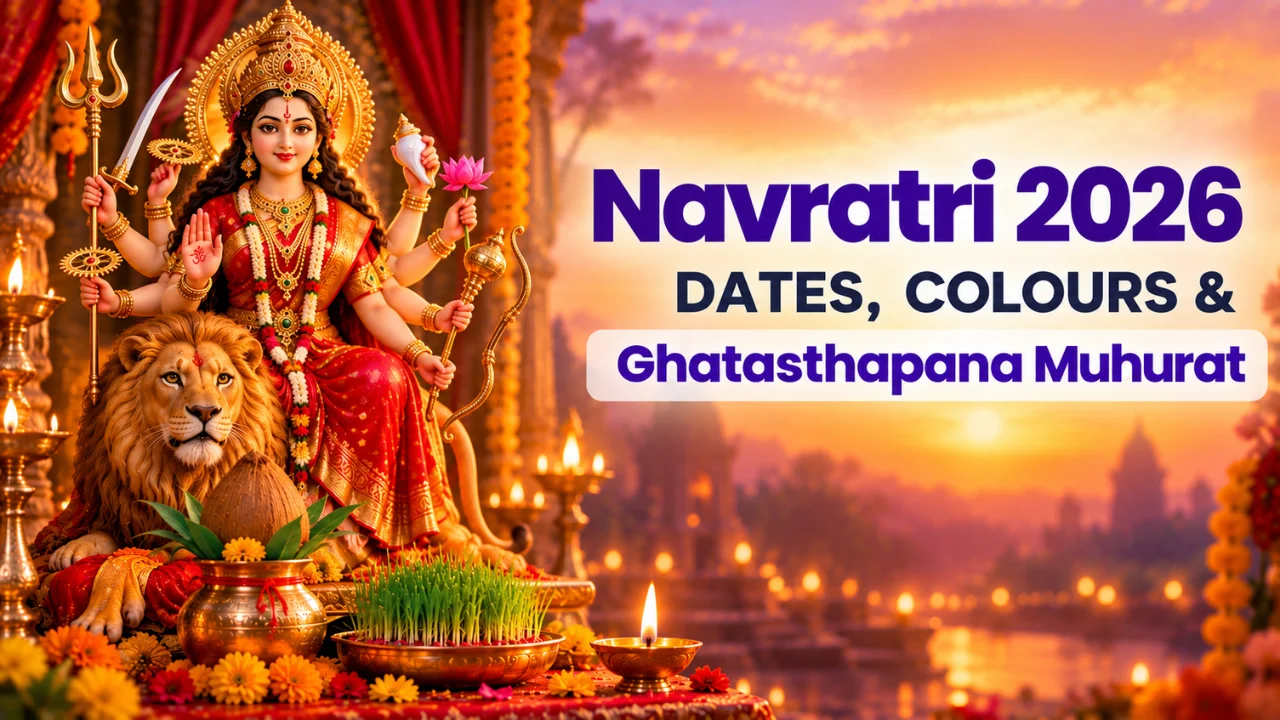
There is a shift you can feel in the week Navratri begins. The evenings fill with the sound of dhaak and dandiya sticks, shop windows turn red and gold, and in countless homes a small clay pot of water, the kalash, is set up with barley sown around it that will sprout green over nine days. Autumn in India has always been a season that seems to wake devotion on its own. For nine nights the Goddess is worshipped in all her forms, gentle and fierce, and on the tenth day good is said to have won.
In 2026, Sharad Navratri begins on Sunday, 11 October, the morning after Pitru Paksha ends, and closes with Vijayadashami on Tuesday, 20 October. Here is the full calendar, the Ghatasthapana muhurat, the nine colours, and a clear answer on Ashtami and Navami, which are not as simple this year.
Ghatasthapana / Day 1: Sunday, 11 October 2026
Ghatasthapana muhurat (Delhi): ~6:19 AM to 10:12 AM (Abhijit ~11:44 AM to 12:31 PM)
Durga Ashtami and Maha Navami: Monday, 19 October (some panchangs keep Ashtami on 18 October)
Sandhi Puja (Delhi): ~10:27 AM to 11:15 AM, 19 October
Vijayadashami (Dussehra): Tuesday, 20 October 2026
The stories behind the nine nights
Navratri, literally the nine nights, is not built on a single legend. The central one is Mahishasura, a buffalo demon who won a boon that no man or god could kill him, and then terrorised the three worlds. The gods poured their combined energy into a single warrior goddess, Durga, riding a lion, each of her ten arms holding a weapon gifted by a different deva. She fought Mahishasura for nine nights and slew him on the tenth day. That victory is Vijayadashami. In the north, the same tenth day carries a second memory, Rama's victory over Ravana, which is why Dussehra ends with Ravana's effigy going up in flames.
The nine forms of Durga, in order
Each night honours a different form of the Goddess:
Shailputri, daughter of the mountains.
Brahmacharini, the serene ascetic.
Chandraghanta, the warrior with a bell-shaped crescent moon on her forehead.
Kushmanda, whose smile is said to have created the universe.
Skandamata, the mother of Kartikeya.
Katyayani, the fierce slayer of Mahishasura.
Kalaratri, the dark one who destroys fear.
Mahagauri, the radiant one, worshipped on Ashtami.
Siddhidatri, the giver of perfection, worshipped on Navami.
This year the Saptami tithi covers two days, 17 and 18 October, and Ashtami and Navami meet on 19 October, so the last few forms don't line up neatly with one date each. Most families simply keep the order and follow their panchang for which form falls on which day.
The nine colours of Navratri 2026
The colour-of-the-day custom is a modern one, popular in Maharashtra and Gujarat, and it follows the weekday Navratri starts on, not scripture. Day 1 this year is a Sunday, so the sequence starts with orange:
11 October: orange
12 October: white
13 October: red
14 October: royal blue
15 October: yellow
16 October: green
17 October: grey
18 October: purple
19 October: peacock green
Enjoy it as a festive extra, not a rule. Wearing the "wrong" colour takes nothing away from your puja.
Ghatasthapana, and its muhurat
Navratri opens with Ghatasthapana, also called Kalash Sthapana, the installation of a sacred pot that invokes the Goddess into the home. Timing matters here. The rite is done in the morning while Pratipada is active, ideally in the first third of the day, and never after midday. For Delhi in 2026 the window runs roughly 6:19 AM to 10:12 AM. If you miss it, the Abhijit muhurat around noon, about 11:44 AM to 12:31 PM, is the accepted fallback. Set a clean chowki in the north-east, cover it with red cloth, fill the kalash with water, sow barley in soil around it, and invoke the Goddess. The barley that sprouts over nine days is watched as a small sign of the year ahead. Sunrise shifts by city, so your exact window will be a few minutes different. This is the one timing worth checking for your own town.
Is Durga Ashtami on 18 or 19 October?
This is where 2026 gets confusing, so here it is plainly. The Saptami tithi is long this year and covers two civil days, 17 and 18 October. By the Drik reckoning, that pushes Ashtami onto Monday, 19 October. It ends in the late morning, around 10:51 AM in Delhi, and Navami begins at the same moment. So Durga Ashtami, Sandhi Puja and Maha Navami all fall on one Monday.
Some panchangs and temples still mark Ashtami on Sunday, 18 October, because the Ashtami tithi begins during that day. Nobody is being careless here; they are simply reading the long Saptami differently. Since this decides when you do Kanya Pujan and the Navami havan, go by the panchang your family or temple follows. Vijayadashami on 20 October is agreed everywhere.
Sandhi Puja and Kanya Pujan
Two observances anchor the end of the nine nights. Sandhi Puja is performed in the 48 minutes around the junction where Ashtami ends and Navami begins, the most charged moment of the festival in the Durga Puja tradition. In Delhi this year that falls around 10:27 AM to 11:15 AM on 19 October. Kanya Pujan, also called Kanjak, is kept on Ashtami or Navami. Young girls are welcomed as living forms of the Goddess, their feet are washed, and they are served puri, halwa and black chana. For many families this simple act is the heart of Navratri.
The Navratri fast, kept steady
Many people fast through all nine days, and there is no single correct level. Some eat one sattvic meal a day, others take only fruit, milk and vrat foods such as sabudana, samak rice, kuttu or singhara flour, and rock salt. Grains, regular salt, onion, garlic, meat and alcohol are set aside. Pick what your body can carry across nine days rather than the strictest option you can think of. If you are unwell, pregnant, or on medication, the fruit and milk route, or a lighter fast, is the sensible one.
The same festival, many forms
Navratri looks completely different depending on where you stand.
Gujarat: nine nights of Garba and Dandiya Raas, whole neighbourhoods dancing in circles until late.
West Bengal, Odisha, Assam: Durga Puja, from Maha Shashthi on 17 October to Bijoya Dashami on 21 October by the Bengali panjika, a day after Dussehra in most of India. Grand pandals, artisan idols, and immersion on the last day.
North India: Ramlila through the nine nights, ending with Dussehra and the burning of Ravana's effigy.
The South: Golu, tiered displays of dolls and figurines, with Saraswati Puja and Ayudha Puja near the end.
Vijayadashami, the tenth day
Vijayadashami, on 20 October 2026, closes the festival. It marks Durga's victory over Mahishasura and Rama's over Ravana, the same idea told twice: light outlasts darkness. It is also one of the few abujh muhurat days of the year, so auspicious that no separate muhurat is needed to begin something new, a business, a course of study, a big purchase. In Bengal the Durga idols are carried to the water, and the Goddess is sent home with the wish that she come back soon.
Frequently asked
When does Navratri begin in 2026?
Sharad Navratri begins on Sunday, 11 October 2026, with Ghatasthapana, and ends with Vijayadashami on 20 October.
What is the Ghatasthapana muhurat?
In Delhi, roughly 6:19 AM to 10:12 AM, with the Abhijit muhurat (about 11:44 AM to 12:31 PM) as a fallback. It shifts slightly by city, and is not done after midday.
Is Durga Ashtami on 18 or 19 October 2026?
By the Drik reckoning, Durga Ashtami and Maha Navami both fall on Monday, 19 October. Some panchangs keep Ashtami on 18 October. Follow your family's panchang.
What are the Navratri 2026 colours?
Orange, white, red, royal blue, yellow, green, grey, purple and peacock green, from 11 to 19 October.
Can I eat rice during the Navratri fast?
Regular rice is not allowed. Samak, often called vrat ke chawal, is fine on a phalahar fast.
When is Dussehra 2026?
Tuesday, 20 October 2026. In Bengal, Bijoya Dashami is kept on 21 October.
For the daily Panchang, every Navratri date from Ghatasthapana to Dussehra, and a reminder before each one, Kaalo keeps the whole Hindu calendar in your pocket, offline.
Get festival reminders
Never miss a festival or vrat. Straight to your inbox.
Never miss a festival
Get festival and vrat reminders in your inbox.